

A chandelier is both a decorative centrepiece and a carefully supported electrical fixture. When its appearance, movement or performance begins to change, the early signs should not be ignored.
Many chandelier problems are straightforward to resolve when identified early. Left unattended, a loose connection can develop into rewiring work, a small fixing issue can place stress on the ceiling, and accumulated grime can conceal damage to crystals, metalwork or suspension points.
The following signs are worth noting in homes, hotels, restaurants, ballrooms, event venues and commercial interiors. Each may indicate that professional chandelier repair and maintenance is required.
1. Flickering or intermittent bulbs
Flickering, pulsing or uneven illumination is one of the most recognisable signs that a chandelier needs attention. A single bulb may cut in and out, or an entire section may become intermittent when the fitting is switched on or dimmed.
What it usually points to
The cause may be a loose bulb, worn lamp holder, failing dimmer, damaged connection or deteriorating wiring. In older chandeliers, the insulation around internal wires can become brittle with age. Modern LED fittings may also develop compatibility issues between the lamps, drivers and dimmer controls.
Why it matters
Repeated flickering places unnecessary stress on the electrical components and can be an early indication of a more significant fault. If replacing a bulb does not resolve the issue, avoid repeatedly switching the chandelier on and off. A specialist can inspect the fitting and determine whether repair, component replacement or chandelier rewiring is the appropriate solution.
2. Buzzing or humming from the fitting
A faint sound from some electrical components can be normal, but a new or increasingly noticeable buzz, hum, crackle or clicking noise deserves investigation. The sound may come from the chandelier itself, the ceiling connection or the dimmer switch.
What it usually points to
Buzzing can result from a loose electrical connection, a failing dimmer, incompatible LED lamps or a component that is beginning to overheat. In some cases, the noise is caused by vibration within a lamp holder or transformer.
Why it matters
A sound that changes when the light is dimmed or switched on may indicate that the electrical system is not operating correctly. Professional inspection can identify the source without unnecessary disturbance to the surrounding room, furnishings or ceiling.
3. Loose, swinging or missing crystals
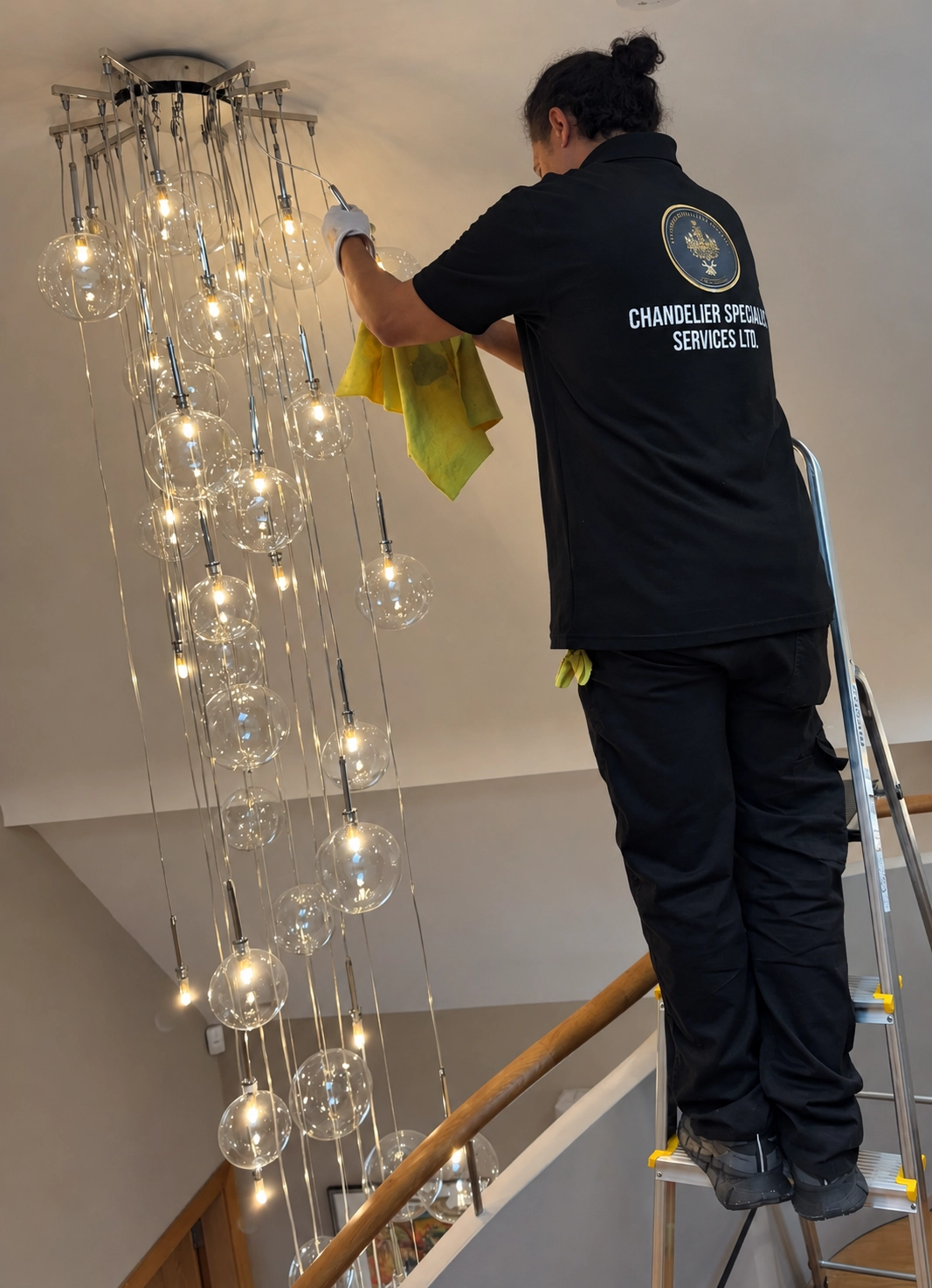
Crystals and glass drops should suspend evenly and remain secure when the chandelier is operating or when the room is subject to normal movement. A drop that swings independently, sits at an unusual angle or appears loose is a visible warning sign.
What it usually points to
The attachment ring, wire, pin or supporting arm may have become worn, bent or displaced. In larger chandeliers, a missing crystal can also affect visual balance across a tier or branch. Repeated movement may indicate that the fitting has been disturbed or that part of the decorative framework requires adjustment.
Why it matters
A loose drop can fall and break, damage furniture or create further imbalance in the chandelier. Because a chandelier hangs above people, a crystal that comes free can also place the safety of guests, staff or residents at risk. A loose crystal should be treated as a safety matter and secured promptly, not left in the hope that it holds. Careful repair can secure the affected elements, replace missing components where possible and preserve the intended arrangement of the design.
Specialist handling is particularly important for antique crystal, Murano glass and bespoke pieces, where replacement parts may need to be matched by size, colour, cut and age.
4. Sagging, tilted or uneven arms
A chandelier should sit securely and appear balanced from every angle. Sagging arms, a tilted canopy, an uneven chain or a visible gap between the ceiling plate and the ceiling indicate that the support system needs to be assessed.
What it usually points to
The issue may involve a loose bracket, worn suspension hardware, a distorted frame or movement in the ceiling fixing. In some properties, the original support was not designed for the chandelier’s weight or the ceiling structure has changed over time.
Why it matters
A decorative fitting must be supported by a structure that is genuinely suitable for its load. Specialist installation and repair are safer than relying on a general contractor who may not routinely assess chandelier-specific suspension points, access requirements and weight distribution.
Our installation site assessment guidance considers the ceiling, electrical connections, access and load before work begins. Where the fixture’s weight demands it, the ceiling structure can be reinforced so the chandelier and its supporting structure remain sound over the long term.
5. Brown or scorched marks around lamp holders
Brown staining, darkened metal, scorching or discolouration around a lamp holder should be treated as a clear indication that the chandelier requires professional attention. The marks may be visible around one socket or across several arms.
What it usually points to
Discolouration can develop from overheating, poor electrical contact, a worn lamp holder or a connection that is not secure. Dust inside the fitting may also retain heat around the lamp holder and surrounding components.
Why it matters
Heat damage can spread and weaken nearby wiring, sockets and decorative materials. The chandelier should not be used until it has been professionally assessed, particularly if the marks are accompanied by a burning smell, unusual warmth or intermittent lighting.
A careful repair may involve replacing lamp holders, improving connections, renewing internal wiring or restoring affected metalwork without compromising the character of the fixture.
6. The chandelier trips a circuit breaker
A circuit breaker that trips when the chandelier is switched on, dimmed or left operating is a sign that the electrical system needs investigation. The problem may occur immediately or only after the fitting has been on for a period of time.
What it usually points to
Possible causes include a short circuit, damaged insulation, moisture, a failed component or a fault within the building’s electrical supply. In older chandeliers, aged wiring is a common reason for repeated circuit interruption.
Why it matters
Resetting the breaker without addressing the cause does not resolve the underlying problem. Repeated trips can place strain on electrical components and interrupt lighting in rooms that are important to the operation of a hotel, venue or commercial property.
Professional chandelier repair and rewiring can identify the fault and restore safe, dependable operation with minimal disruption.
7. Corrosion or rust on fixings and suspension points
Rust, green oxidation, pitting or flaking metal around chains, hooks, ceiling plates, brackets and other suspension points should not be regarded as purely cosmetic. Corrosion can be especially noticeable in properties with high humidity, coastal exposure, kitchens or changing environmental conditions.

What it usually points to
The finish may be deteriorating, or moisture may have reached the underlying metal. Corrosion can also affect screws, rings and concealed fixings that are not immediately visible from floor level.
Why it matters
As metal weakens, the integrity of the suspension system may be affected. Early attention can allow parts to be cleaned, polished, treated or replaced before the damage becomes more extensive.
A specialist assessment also considers whether corrosion has reached the fixing points themselves. This is particularly important for large chandeliers installed above staircases, reception areas, dining rooms and public spaces.
8. Dust or grime build-up is masking damage
A dull appearance, heavy dust around the arms or dark deposits on crystals can be an obvious sign that the chandelier needs professional cleaning. More importantly, grime can hide loose components, hairline damage, corrosion and heat marks.
What it usually points to
Dust often gathers on upper surfaces, lamp holders, suspension chains and areas that are difficult to reach safely. Grease and airborne residue may build up in kitchens, restaurants and busy hospitality environments.
Why it matters
A dirty chandelier may lose much of its brilliance, but the deeper concern is that concealed problems can remain unnoticed. Professional cleaning provides an opportunity to inspect the fixture while carefully removing residue from crystal, glass, brass, chrome, nickel or gold finishes.
Our team uses appropriate methods for the material, design and condition of each chandelier. Cleaning, minor repairs and maintenance can be planned together, helping to preserve the fitting and avoid unnecessary future work.
Early repair protects the whole installation
A chandelier should be assessed as a complete installation rather than as a collection of separate decorative parts. Electrical performance, suspension hardware, ceiling structure, crystals, finishes and access requirements all influence its safe long-term condition.
For fixtures above 20 kg, our documented chandelier load testing and safety procedure records testing at up to 50 per cent above the chandelier’s own weight. Where necessary, ceiling reinforcement is completed so the structure is sized to carry more than the fixture alone.
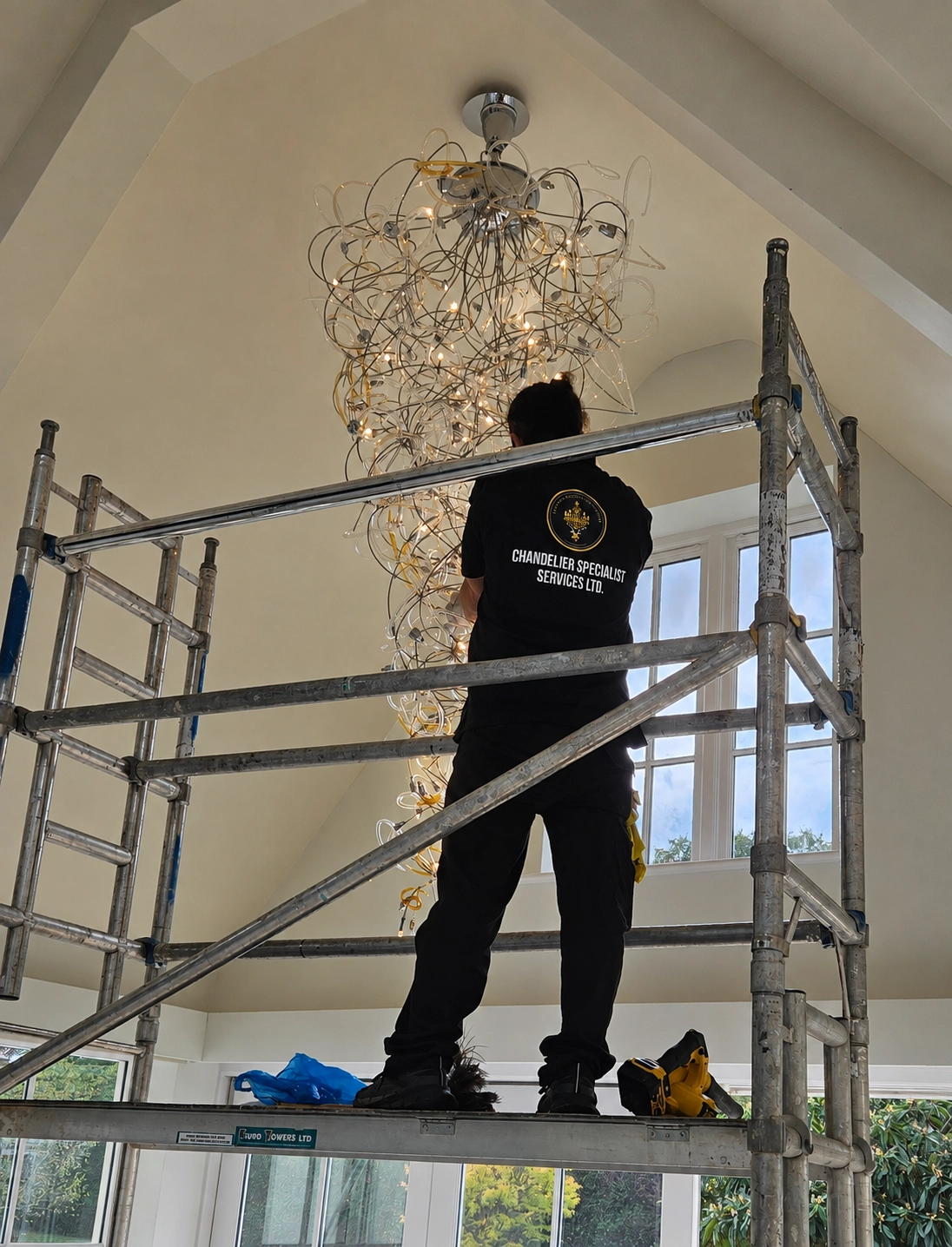
Work at height is planned carefully. The business owner holds PASMA and IPAF credentials, supporting the safe use of suitable access equipment and the planning of high-level work. The property is protected throughout, with access and working methods arranged to maintain a refined finish and minimise disruption.
A planned maintenance schedule can combine inspection, cleaning, bulb replacement, polishing, minor repairs and rewiring where required. For hotels, venues and commercial buildings, scheduled visits, typically every three or six months on a 12-month minimum term, help identify changes before they affect presentation, operation or the wider structure.
A considered approach to chandelier repair
Flickering bulbs, buzzing wires, loose crystals, tilted arms, scorch marks, tripped breakers, corrosion and concealed grime are all reasons to arrange a professional assessment. Many issues are relatively economical to correct early and considerably more involved when ignored.
Chandelier Specialist Services provides tailored repair, rewiring, maintenance and installation support for antique, modern and bespoke fixtures across residential and commercial properties.
Contact us to discuss the condition of your chandelier and the appropriate next step.
